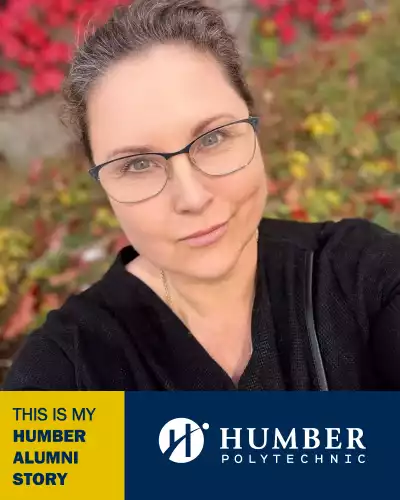
AMELIA THORNTON (she/her)
Emergency Telecommunications - 2019
What brought you to Humber and your program of study?
I considered a career in policing when I was younger, but didn’t pursue it at the time. Instead, I built a 30-year career spanning oil and gas in Calgary and the insurance industry in Ontario, where I started as a telephone auto physical damage adjuster and eventually led a national data migration for a $100 million software project.
After losing a close friend, I reassessed what I wanted my work to contribute. Around that same time, I saw a friend graduate from Humber’s Emergency Telecommunications program and begin working as a dispatcher. It felt like a way to move into public safety in a meaningful, human-centred role without following a traditional frontline path.
What was your favourite Humber memory or experience?
It was an accelerated, high-demand program, and I approached it with a clear objective: perform at a high level and transition into the field.
The most meaningful moment was receiving the Award of Academic Excellence at convocation for achieving the highest GPA across both graduating cohorts that year. It was unexpected, and it validated the discipline and focus I brought to the program.
What was Humber's greatest impact on your personal and professional life?
Professionally, Humber provided the entry point into emergency communications and expanded my network within public safety.
More recently, the alumni network has continued to shape my path. Through Humber, I connected with a fellow graduate who later became a guest on my podcast, reinforcing how those relationships evolve over time.
More broadly, the program helped refine my ability to communicate clearly and calmly in high-pressure environments, a skill set that continues to influence my work today.
What are you up to now?
I’m the creator, co-host, and producer of a self-funded Canadian podcast, The Other Side of the Call, which explores the human impact of public safety work and the tools that support balance, recovery, and long-term resilience.
The show brings together first responders, clinicians, researchers, and peer support leaders from across the country to examine trauma exposure, recovery, and the systems that shape those experiences.
As a journalism graduate, I draw on a foundation in storytelling, interviewing, and public communication to guide these conversations in ways that are both accessible and grounded in lived experience.
While my own recovery from post-traumatic stress remains non-linear, I am actively rebuilding capacity and continuing multi-modality therapy, with the goal of returning to sustainable, meaningful work that contributes to this space and others like it.
What else do you want to share (e.g. Memorable trip; If you had a superpower; Favourite food or coffee shop; Personal and professional interests; Awards and recognition; Other milestones)?
I’ve had a few very different careers, from oil and gas to insurance to running a wedding and portrait photography business for over a decade, with work across Canada and internationally. What connects all of them is a focus on people, how they communicate, what they carry, and what often goes unspoken.
Creating The Other Side of the Call came at a very different point in my life. After stepping away from frontline work due to injury, I found it was a way to reconnect with purpose and contribute to conversations I felt were missing.